How to Measure Length in Millimeters and Convert It to Inches
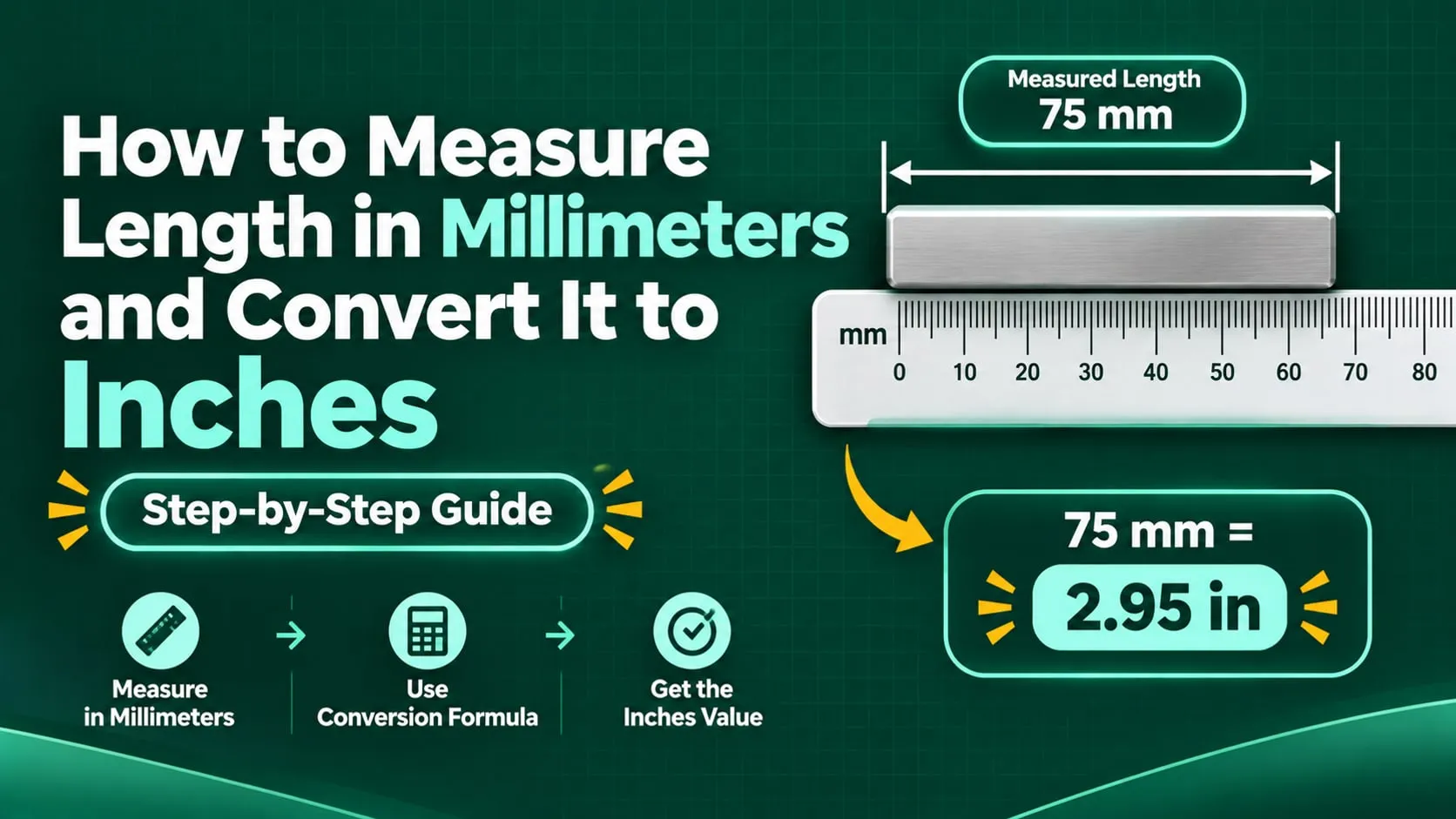
To measure length in millimeters and convert it to inches, measure the object with a tool whose smallest division is finer than the accuracy required, record the reading in millimeters, divide it by 25.4 and round the inch result to the same precision as the measurement. A ruler reading of 47 mm converts to 1.85 inches, and a caliper reading of 47.00 mm converts to 1.8504 inches. The tool, not the formula, sets how many decimal places the inch result carries.
The sections below cover tool selection, measuring technique for rulers, tapes and calipers, accuracy limits under European tape measure classes, temperature effects and the rounding rule that keeps the converted inch value honest.
Which Tools Measure Length in Millimeters?
There are 5 common tools that measure length in millimeters: the steel rule, the tape measure, the vernier caliper, the digital caliper and the micrometer. Each tool has a resolution (the smallest reading it shows) and a typical range.
The table below compares the 5 tools by resolution, range and the inch decimal places that match the resolution.
| Tool | Resolution | Typical range | Matching inch decimals |
|---|---|---|---|
| Steel rule | 1 mm or 0.5 mm | 150 to 1,000 mm | 2 places (0.02 to 0.04 in) |
| Tape measure | 1 mm | 3 to 10 m | 2 places |
| Vernier caliper | 0.02 mm or 0.05 mm | 0 to 150 mm | 3 places (0.001 to 0.002 in) |
| Digital caliper | 0.01 mm | 0 to 150 mm | 4 places (0.0004 in) |
| Micrometer | 0.01 mm or 0.001 mm | 0 to 25 mm per frame | 4 to 5 places |
Tool choice follows the object size and the tolerance. A room needs a tape measure. A bolt diameter needs a caliper. A bearing bore held to a few thousandths of a millimeter needs a micrometer.
How Do You Measure Length in Millimeters With a Ruler or Tape?
To measure length in millimeters with a ruler or tape, align the zero line with one end of the object, view the far end straight on and read the last whole millimeter line. A ruler and a tape share the same technique, with 2 differences at the tape’s hook end.
Follow these 5 steps:
- Place the ruler’s zero line, not the physical end, on the start of the object.
- Hold the ruler flat and parallel to the edge being measured.
- Look straight down at the far end to remove parallax.
- Read the last numbered centimeter line, multiply by 10 and add the millimeter lines past it.
- Record the reading with its unit, such as 452 mm.
A tape measure’s hook slides by its own thickness. The hook pulls out for outside measurements and pushes in for inside measurements, so both start at true zero. A tape held to a wall corner uses the case length printed on the tape body for inside measurements. The line hierarchy on each scale is explained in how to read millimeters and inches on a ruler.
How Do You Measure Length in Millimeters With a Caliper?
To measure length in millimeters with a caliper, close the jaws, zero the display, open the jaws past the object, close them gently on it and read the display or the vernier scale. Calipers measure outside size, inside size and depth with 3 different contact points.
Follow these 4 steps with a digital caliper:
- Clean the jaw faces and close the jaws fully.
- Press the zero button with the jaws closed.
- Close the outside jaws on the object with light, steady pressure.
- Read the value in millimeters to 2 decimal places.
A vernier caliper reads in 2 parts. The main scale gives whole millimeters before the vernier zero line. The vernier line that aligns exactly with a main scale line gives the hundredths. A reading of 21 mm on the main scale and alignment at the 15th line of a 0.02 mm vernier gives 21 + 15 × 0.02 = 21.30 mm.
Most digital calipers include an inch/mm button. Switching units on the display converts with the same 25.4 factor and shows 0.0005 inch resolution in inch mode, which equals 0.0127 mm.
How Accurate Is a Tape Measure in Millimeters?
A tape measure’s accuracy is set by its accuracy class, which grows with tape length. The European Measuring Instruments Directive (2014/32/EU, Annex MI-008) defines the maximum permissible error for Class I as ±(0.1 + 0.1 × L) mm, for Class II as ±(0.3 + 0.2 × L) mm and for Class III as ±(0.6 + 0.4 × L) mm, where L is the length in meters rounded up to the next whole meter.
The table below applies those formulas to 4 tape lengths.
| Length | Class I | Class II | Class III |
|---|---|---|---|
| 1 m | ±0.2 mm | ±0.5 mm | ±1.0 mm |
| 3 m | ±0.4 mm | ±0.9 mm | ±1.8 mm |
| 5 m | ±0.6 mm | ±1.3 mm | ±2.6 mm |
| 10 m | ±1.1 mm | ±2.3 mm | ±4.6 mm |
A Class II tape across a 5 m room carries up to 1.3 mm of error, which equals 0.05 inch. Converting that room length to inches with 4 decimal places reports precision the tape never had. The class mark (I, II or III in an oval) is printed on the blade of certified tapes.
How Does Temperature Change a Millimeter Measurement?
Temperature changes a millimeter measurement because steel expands about 0.0117 mm per meter for every degree Celsius above the reference temperature of 20 °C. ISO 1 sets 20 °C as the standard reference temperature for dimensional measurement.
A 5 m steel tape at 30 °C grows by 5 × 10 × 0.0117 = 0.585 mm. Every length read on that tape reads short by up to 0.585 mm at full extension. The effect equals 0.023 inch, which is invisible on a 1/16 inch scale and significant on a caliper reading to 0.01 mm. Calipers and micrometers face the same effect on a smaller scale, and holding a caliper in a warm hand for several minutes shifts a precision reading.
How Do You Convert a Millimeter Measurement to Inches Without Adding False Precision?
To convert a millimeter measurement to inches without adding false precision, divide by 25.4 and keep only the inch decimal places that match the tool’s resolution. 1 mm equals 0.039 inch, so a reading to the nearest millimeter supports 2 inch decimal places and no more.
The 3 examples below show the same rule for 3 tools:
- Tape reading of 3,612 mm: 3,612 ÷ 25.4 = 142.2047 in. The tape resolves 1 mm (0.04 in), so the result is 142.20 in, or 11 ft 10.20 in.
- Ruler reading of 47.5 mm: 47.5 ÷ 25.4 = 1.87008 in. A half millimeter equals 0.02 inch, so the reading supports 1.87 in.
- Caliper reading of 7.94 mm: 7.94 ÷ 25.4 = 0.312598 in. The 0.01 mm caliper supports 0.3126 in, which matches 5/16 inch (0.3125 in) within 0.0001 inch.
The conversion factor 25.4 is exact and adds no uncertainty, and the MM to inches converter applies it to any reading. All of the uncertainty comes from the measurement. The rounding of fractional results, such as 1/16 or 1/64 inch, is covered in how to convert MM to fractional inches, and room-scale results in feet and inches are covered in converting millimeters to feet and inches.
What Are the Most Common Errors When Measuring in Millimeters?
There are 6 common errors when measuring in millimeters and converting to inches. Each one has a direct fix.
- Parallax: Reading the scale at an angle shifts the apparent position of the line. Viewing straight down fixes it.
- Worn ruler end: A rounded end starts the scale short. Starting at the 10 mm line and subtracting 10 fixes it.
- Sagging tape: An unsupported tape over a long span reads long. Supporting the tape or using a laser distance meter fixes it.
- Jaw pressure: Squeezing caliper jaws flexes the frame and the part. Light, repeatable pressure fixes it.
- Unit mix-up: Reading the inch edge of a dual-scale ruler as millimeters. Checking which edge is numbered to 30 fixes it.
- Wrong divisor: Dividing by 2.54 gives a result 10 times too large. Dividing millimeters by 25.4, or centimeters by 2.54, fixes it.
Frequently Asked Questions
What is the most accurate way to measure in millimeters?
The most accurate everyday way to measure in millimeters is a micrometer, which reads to 0.01 mm or 0.001 mm. A digital caliper reads to 0.01 mm over a wider 150 mm range.
How many decimal places does a converted inch value keep?
A converted inch value has 2 decimal places for a 1 mm reading and 4 decimal places for a 0.01 mm reading. The inch decimals match the tool’s resolution divided by 25.4.
Can a tape measure read in both mm and inches?
Yes, dual-scale tape measures print millimeters on one edge and inches on the other. Readings convert between edges by dividing or multiplying by 25.4.
Why does my caliper show 0.0005 inch resolution?
A digital caliper shows 0.0005 inch resolution because its 0.01 mm metric resolution converts to about 0.0004 inch, and inch mode rounds to the nearest half thousandth.
Does temperature affect a ruler measurement?
Yes, steel lengthens about 0.0117 mm per meter per °C. The effect matters only for precision readings, such as caliper work to 0.01 mm.
Measuring Length in Millimeters and Converting It to Inches: Summary
Measuring length in millimeters and converting it to inches combines 2 tasks: a measurement with known resolution and a conversion with an exact factor. Rulers and tapes resolve 1 mm, calipers resolve 0.01 to 0.05 mm and micrometers resolve down to 0.001 mm. Dividing by 25.4 converts each reading, and the inch result keeps only the decimal places the tool supports. Following that rule keeps every length measured in millimeters and converted to inches as accurate as the measurement itself.