Converting Millimeters to Feet and Inches: Formula and Examples
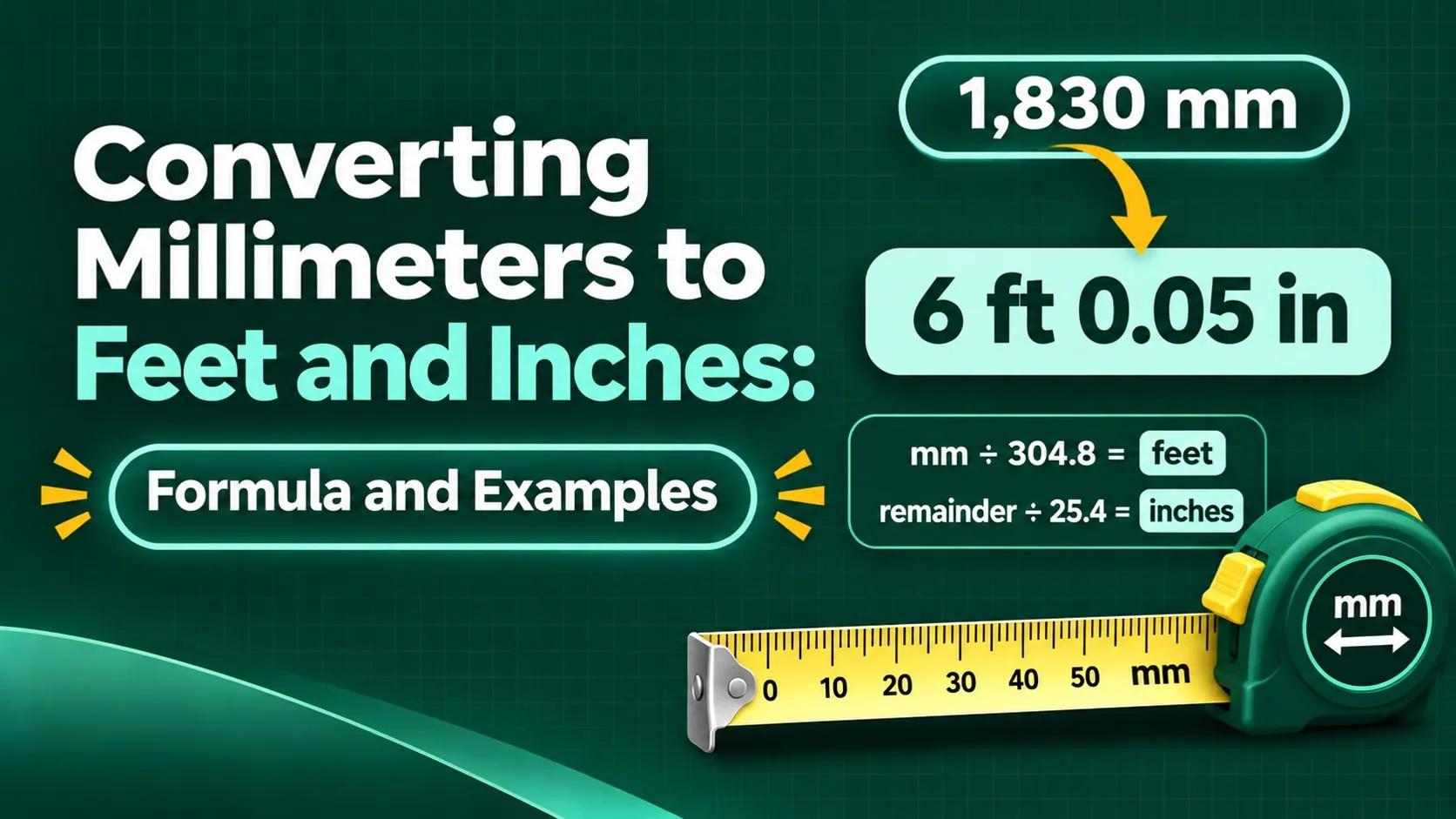
Converting millimeters to feet and inches takes 2 steps: divide the millimeters by 25.4 to get total inches, then divide the total inches by 12, keeping the whole number as feet and the remainder as inches. 1,800 mm equals 70.87 inches, which equals 5 feet 10.87 inches. One foot equals exactly 304.8 mm, and one inch equals exactly 25.4 mm.
Feet-and-inches results appear in heights, room sizes, door openings and lumber lengths. The formula, a reference table, a spreadsheet formula and 8 worked examples follow.
What Is the Formula for Millimeters to Feet and Inches?
The formula for millimeters to feet and inches is feet = whole part of (mm ÷ 304.8), and inches = (mm ÷ 25.4) − (feet × 12). Both divisors are exact, since the International Yard and Pound Agreement of 1959 fixed the foot at 0.3048 m and the inch at 0.0254 m.
The formula has 3 parts:
- Total inches: mm ÷ 25.4.
- Whole feet: the whole number part of total inches ÷ 12.
- Remaining inches: total inches minus whole feet × 12.
The same result comes from dividing by 304.8 first. 1,800 ÷ 304.8 = 5.9055 feet. The whole part is 5 feet. The decimal part, 0.9055 feet, times 12 equals 10.87 inches. Both routes give 5 feet 10.87 inches.
How Do You Convert Millimeters to Feet and Inches Step by Step?
To convert millimeters to feet and inches step by step, convert to total inches first, then split the total into feet and inches. Rounding happens last, after the split.
Follow these 4 steps for 2,100 mm:
- Divide by 25.4: 2,100 ÷ 25.4 = 82.677 inches.
- Divide the total inches by 12: 82.677 ÷ 12 = 6.89, so the whole feet equal 6.
- Subtract the inches in 6 feet: 82.677 − 72 = 10.677 inches.
- Round the remainder: 10.677 inches rounds to 10.68 inches, or 10 11/16 inches to the nearest 1/16.
2,100 mm equals 6 feet 10.68 inches. A metric door height of 2,100 mm is 2.68 inches taller than the US standard door height of 6 feet 8 inches (2,032 mm).
What Are the Exact MM Values for Whole Feet?
The exact MM values for whole feet are multiples of 304.8 mm. These benchmarks speed up mental conversion, because the remainder after the nearest benchmark is small.
The table below lists whole feet from 1 to 10 with their exact millimeter values.
| Feet | Millimeters (exact) | Meters |
|---|---|---|
| 1 ft | 304.8 mm | 0.3048 m |
| 2 ft | 609.6 mm | 0.6096 m |
| 3 ft (1 yd) | 914.4 mm | 0.9144 m |
| 4 ft | 1,219.2 mm | 1.2192 m |
| 5 ft | 1,524.0 mm | 1.524 m |
| 6 ft | 1,828.8 mm | 1.8288 m |
| 7 ft | 2,133.6 mm | 2.1336 m |
| 8 ft | 2,438.4 mm | 2.4384 m |
| 9 ft | 2,743.2 mm | 2.7432 m |
| 10 ft | 3,048.0 mm | 3.048 m |
Two rows give clean anchors: 5 feet is exactly 1,524 mm and 10 feet is exactly 3,048 mm. A value like 1,600 mm sits 76 mm above 5 feet. 76 mm divided by 25.4 equals 2.99 inches, so 1,600 mm is 5 feet 2.99 inches, close to 5 feet 3 inches.
How Do You Convert Height in Millimeters to Feet and Inches?
To convert height in millimeters to feet and inches, divide the height by 25.4, split the total inches into feet and remainder and round the remainder to the nearest whole or half inch. Medical and identity records in metric countries list height in centimeters or millimeters, while US records use feet and inches.
The table below converts common adult heights from 1,500 mm to 2,000 mm in 50 mm steps.
| Height (mm) | Height (cm) | Total inches | Feet and inches |
|---|---|---|---|
| 1,500 | 150 | 59.06 | 4 ft 11.06 in |
| 1,550 | 155 | 61.02 | 5 ft 1.02 in |
| 1,600 | 160 | 62.99 | 5 ft 2.99 in |
| 1,650 | 165 | 64.96 | 5 ft 4.96 in |
| 1,700 | 170 | 66.93 | 5 ft 6.93 in |
| 1,750 | 175 | 68.90 | 5 ft 8.90 in |
| 1,800 | 180 | 70.87 | 5 ft 10.87 in |
| 1,850 | 185 | 72.83 | 6 ft 0.83 in |
| 1,900 | 190 | 74.80 | 6 ft 2.80 in |
| 1,950 | 195 | 76.77 | 6 ft 4.77 in |
| 2,000 | 200 | 78.74 | 6 ft 6.74 in |
Each 50 mm step adds 1.97 inches, just under 2 inches. A 1,850 mm height crosses the 6-foot line by 0.83 inches, because 6 feet equals 1,828.8 mm.
How Do You Convert Room and Building Dimensions to Feet and Inches?
To convert room and building dimensions to feet and inches, apply the same 2-step formula and round the inches to the nearest 1/8 or 1/16 inch when the result goes on a drawing or cut list.
The table below converts common metric building dimensions.
| Item | Metric size | Feet and inches | Nearest US standard |
|---|---|---|---|
| Kitchen counter height | 900 mm | 2 ft 11.43 in | 36 in (914.4 mm) |
| Interior door height | 2,100 mm | 6 ft 10.68 in | 6 ft 8 in (2,032 mm) |
| Ceiling height | 2,400 mm | 7 ft 10.49 in | 8 ft (2,438.4 mm) |
| Ceiling height | 2,700 mm | 8 ft 10.30 in | 9 ft (2,743.2 mm) |
| Plywood sheet | 1,220 × 2,440 mm | 4 ft 0.03 in × 8 ft 0.06 in | 4 × 8 ft (1,219.2 × 2,438.4 mm) |
| Room | 3,600 × 4,500 mm | 11 ft 9.73 in × 14 ft 9.17 in | 12 × 15 ft |
Metric plywood at 1,220 × 2,440 mm runs 0.8 mm and 1.6 mm larger than a true 4 × 8 foot sheet. That gap is small enough for the two sizes to substitute in most framing work. A 2,400 mm ceiling is 1.51 inches lower than a US 8-foot ceiling.
What Happens When the Remainder Rounds Up to 12 Inches?
When the remainder rounds up to 12 inches, add 1 to the feet and set the inches to 0. A result of “5 feet 12 inches” is not valid notation.
1,828 mm shows the problem. 1,828 ÷ 25.4 = 71.97 inches, which splits into 5 feet 11.97 inches. Rounded to the nearest whole inch, 11.97 becomes 12, so the correct answer is 6 feet 0 inches, not 5 feet 12 inches. Rounding the total inches before the split avoids this error: 71.97 rounds to 72 inches, and 72 ÷ 12 = 6 feet exactly.
How Do You Convert MM to Feet and Inches in Excel or Google Sheets?
To convert MM to feet and inches in Excel or Google Sheets, round the total inches first, then use INT for the feet and MOD for the inches. For a millimeter value in cell A2, the formula below returns a text result such as 5’ 10.9”.
=INT(ROUND(A2/25.4,1)/12)&“’ “&ROUND(MOD(ROUND(A2/25.4,1),12),1)&”“””
The formula has 3 functions with 3 roles:
- ROUND(A2/25.4,1) converts millimeters to total inches with 1 decimal place.
- INT(…/12) returns the whole feet.
- ROUND(MOD(…,12),1) returns the inches left after the whole feet, cleaned of floating-point digits.
Rounding inside the formula prevents the 12-inch remainder error described above. Excel’s CONVERT function returns decimal feet with =CONVERT(A2,“mm”,“ft”), but it does not split feet and inches. The MM to inches converter returns the total inches for step 1 of the manual method.
What Are 8 Worked Examples of MM to Feet and Inches?
The 8 worked examples below show the total inches, the split and the final feet-and-inches value for lengths from 450 mm to 10,000 mm.
- 450 mm ÷ 25.4 = 17.72 in, which equals 1 ft 5.72 in.
- 600 mm ÷ 25.4 = 23.62 in, which equals 1 ft 11.62 in.
- 762 mm ÷ 25.4 = 30 in, which equals 2 ft 6 in exactly.
- 1,220 mm ÷ 25.4 = 48.03 in, which equals 4 ft 0.03 in.
- 2,032 mm ÷ 25.4 = 80 in, which equals 6 ft 8 in exactly.
- 3,000 mm ÷ 25.4 = 118.11 in, which equals 9 ft 10.11 in.
- 5,000 mm ÷ 25.4 = 196.85 in, which equals 16 ft 4.85 in.
- 10,000 mm ÷ 25.4 = 393.70 in, which equals 32 ft 9.70 in.
Examples 3 and 5 give exact answers because 762 and 2,032 are whole multiples of 25.4. Examples 6 to 8 show how the inch remainder varies even when the millimeter values are round numbers. More graded questions in the same format appear in the MM to inches worked examples and practice questions.
Frequently Asked Questions
How many millimeters are in one foot?
One foot contains exactly 304.8 millimeters. The value comes from 12 inches × 25.4 mm per inch.
What is 1,700 mm in feet and inches?
1,700 mm is 5 feet 6.93 inches, close to 5 feet 7 inches. The working is 1,700 ÷ 25.4 = 66.93 inches, and 66.93 − 60 = 6.93 inches.
Is 6 feet more than 1,800 mm?
Yes, 6 feet is 1,828.8 mm, which is 28.8 mm (1.13 inches) more than 1,800 mm.
How do you write feet and inches correctly?
Feet and inches are written as 5 ft 10 in, or 5′ 10″ with the prime and double prime symbols. The decimal 5.9 ft means 5 feet 10.8 inches, not 5 feet 9 inches.
Can you convert mm to feet without converting to inches first?
Yes, divide the millimeters by 304.8 to get decimal feet. Multiply the decimal part by 12 to get the inches. 3,000 mm ÷ 304.8 = 9.8425 feet, and 0.8425 × 12 = 10.11 inches.
Converting Millimeters to Feet and Inches: Summary
Converting millimeters to feet and inches follows one formula: divide by 25.4 for total inches, then split by 12 into feet and inches. The exact anchors are 304.8 mm per foot and 25.4 mm per inch. Heights, doors, ceilings and sheet goods convert with the same 2 steps. Rounding the total inches before the split keeps every millimeters to feet and inches result in valid notation.