Metric vs Imperial Measurements: Understanding MM and Inches
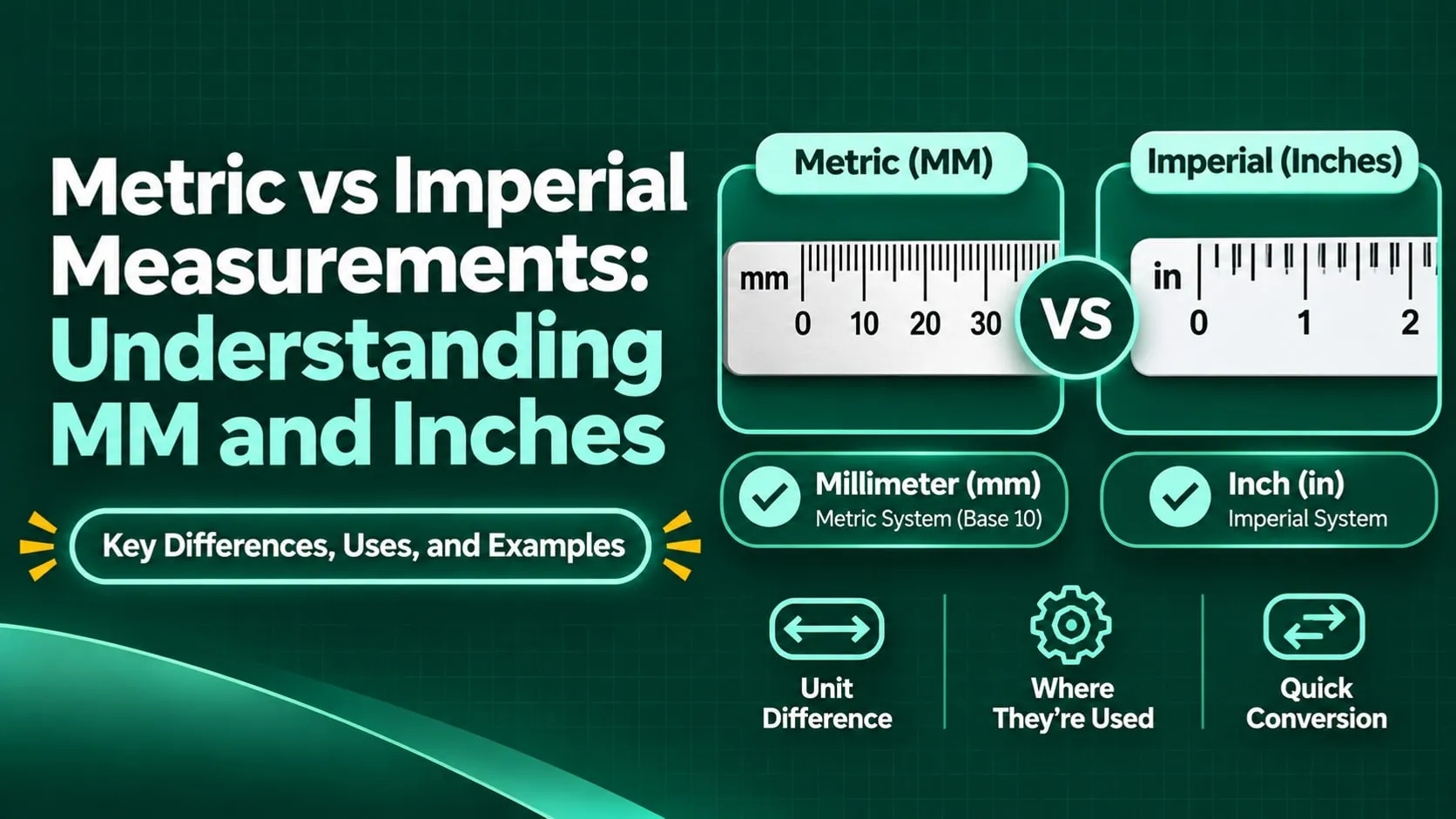
The metric and imperial systems measure length on different scales: the metric system divides the meter by powers of 10, so 1 millimeter is 1/1,000 of a meter, while the imperial system divides the foot into 12 inches and the inch into halves, quarters, eighths and sixteenths. The two systems share one fixed bridge. Since 1959, one inch has been defined as exactly 25.4 millimeters, which makes the inch a metric-derived unit.
Millimeters and inches are the working units of each system for small lengths. Their differences in structure, notation, precision and legal status explain why conversion errors still occur in engineering, construction and trade.
What Is a Millimeter in the Metric System?
A millimeter is a unit of length equal to one thousandth of a meter (0.001 m) in the International System of Units (SI). The prefix “milli” means 1/1,000. Ten millimeters make 1 centimeter, and 1,000 millimeters make 1 meter.
The meter itself rests on a physical constant. The 17th General Conference on Weights and Measures (CGPM) defined the meter in 1983 as the distance light travels in a vacuum in 1/299,792,458 of a second. The International Bureau of Weights and Measures (BIPM) in Sèvres, France, maintains the SI definitions. Because the millimeter is a fixed fraction of the meter, every millimeter traces back to the speed of light.
What Is an Inch in the Imperial System?
An inch is a unit of length equal to 1/12 of a foot and 1/36 of a yard in the British imperial and US customary systems. The word comes from the Latin uncia, meaning one twelfth. A statute of Edward II in 1324 described the inch as 3 barleycorns, dry and round, laid end to end.
Today the inch has no independent physical standard. The International Yard and Pound Agreement of 1959 defined the yard as exactly 0.9144 meters. One inch, as 1/36 of that yard, equals exactly 0.0254 meters, or 25.4 millimeters. The full history of that value is covered in why one inch is equal to exactly 25.4 millimeters.
What Are the Differences Between MM and Inches?
There are 6 structural differences between millimeters and inches: base, subdivision, notation, unit steps, definition and official status. The table below compares them side by side.
| Attribute | Millimeter (metric) | Inch (imperial and US customary) |
|---|---|---|
| Size | 0.001 m | 0.0254 m (25.4 mm) |
| Subdivision | Decimal: 0.1 mm, 0.01 mm, 0.001 mm (1 µm) | Fractional: 1/2, 1/4, 1/8, 1/16, 1/32, 1/64; decimal thou (0.001 in) in machining |
| Notation | 47 mm, 47.5 mm | 1 7/8 in, 1.875″ |
| Larger units | cm (×10), m (×1,000), km (×1,000,000) | foot (×12), yard (×36), mile (×63,360) |
| Definition source | Speed of light, via the SI meter | 0.9144 m yard, via the 1959 agreement |
| Official status | Official in every country except 3 | Primary in the US; partial in the UK and Canada |
The unit steps show the central difference. Moving between metric units shifts a decimal point. Moving between imperial units multiplies by 12, 3 or 1,760. A 3,048 mm board equals 3.048 m in one step, while the same board equals 120 inches, 10 feet or 3.33 yards through 3 different factors.
How Much Larger Is an Inch Than a Millimeter?
An inch is 25.4 times larger than a millimeter. One millimeter equals 0.03937 inches, about 1/25 of an inch. The smallest common inch fraction on a ruler, 1/16 inch, equals 1.5875 mm, which is 1.59 times one millimeter. The MM to inches converter and the inches to MM converter apply the 25.4 factor in both directions.
Is the Imperial Inch the Same as the US Inch?
Yes, the imperial inch and the US inch have been identical since the 1959 agreement, both at 25.4 mm. Before 1959 they differed slightly. The US inch measured 25.4000508 mm under the Mendenhall Order of 1893, and the UK inch measured 25.399977 mm under the Imperial Standard Yard.
The UK adopted the international yard for all purposes through the Weights and Measures Act 1963, effective 1 January 1964. Imperial and US customary systems still differ for volume, such as the imperial gallon (4.546 liters) and the US gallon (3.785 liters), but for length the 2 systems use the same inch, foot and yard.
Which Countries Use Inches Instead of Millimeters?
3 countries have not adopted the metric system as their primary system: the United States, Liberia and Myanmar, according to the CIA World Factbook. Every other country uses the metric system officially, though several keep inches in specific trades.
The 4 country profiles below show how mixed use works in practice:
- United States: Inches and feet dominate construction, consumer products and road signs. The Metric Act of 1866 made metric units legal in trade, the US signed the Metre Convention of 1875 as an original member and the Metric Conversion Act of 1975 set a policy of voluntary conversion.
- United Kingdom: Metric units are official for trade and engineering. Road distances stay in miles, and height is still widely stated in feet and inches.
- Canada: Metric units are official. Lumber, plywood and many building materials are still sold in inch and foot sizes because of trade with the US.
- Myanmar: The Ministry of Commerce announced preparation for metric adoption in 2013. Road signs and temperatures have moved to metric units.
Which Industries Use MM and Which Use Inches?
Industries use millimeters for engineering and manufacturing drawings in most of the world, while inches persist in products standardized in the US or the UK before metrication. Several products mix both units in one specification.
The table below lists 8 product categories and their length units.
| Product or field | Unit in use | Example |
|---|---|---|
| Car tires | mm for width, inches for rim | 225/45R17: 225 mm wide, 17 in rim |
| TV and monitor screens | Inches (diagonal) | 55 in screen = 1,397 mm diagonal |
| Lumber in North America | Nominal inches | 2×4 measures 1.5 × 3.5 in (38 × 89 mm) |
| Pipe threads | Inch-based thread standards worldwide | 1/2 in pipe thread fittings in metric countries |
| Camera lenses | mm (focal length) | 50 mm lens |
| Rainfall | mm in most countries, inches in the US | 25.4 mm = 1 in of rain |
| Paper | mm in ISO countries, inches in the US | A4 = 210 × 297 mm; Letter = 8.5 × 11 in |
| Aviation altitude | Feet in most airspace | 35,000 ft = 10,668 m |
The table shows that the choice of unit follows the origin of the standard, not the country of use. A metric-country mechanic still fits a 17-inch rim, and a US photographer still buys a 50 mm lens.
What Happens When MM and Inches Are Mixed Up?
When MM and inches are mixed up, the error equals a factor of 25.4 in length, or a different factor for derived units such as force, mass and fuel. Two documented cases show the cost.
The NASA Mars Climate Orbiter was lost on 23 September 1999. Ground software produced thruster impulse data in pound-force seconds, while the navigation software expected newton seconds. One pound-force second equals 4.45 newton seconds, so the trajectory error built up over the 9-month cruise and the spacecraft entered the Martian atmosphere too low. Guinness World Records lists the $327.6 million mission as the most expensive metric-imperial conversion error.
Air Canada Flight 143 ran out of fuel in flight on 23 July 1983 after the fuel load was calculated in pounds instead of kilograms. The Boeing 767 carried less than half of the fuel required and glided to a landing at a former air force base in Gimli, Manitoba. Both cases involved derived units, but the root error, a missing or wrong conversion factor, is the same error that turns 50 mm into 19.69 inches when 2.54 replaces 25.4.
Which System Gives More Precise Measurements?
Neither system is more precise by definition, because precision depends on the instrument’s smallest division, not on the unit. A metric ruler reads to 1 mm, a 1/32 inch ruler reads to 0.79 mm and a digital caliper reads to 0.01 mm or 0.0005 inch in either mode.
The metric system makes precision easier to state. 12.35 mm shows its resolution in its decimal places. The imperial system states the same length as 0.486 inch in decimal form, while the nearest fraction, 31/64 inch, drops 0.05 mm of that detail. Machinists in the US use the thou, 0.001 inch (0.0254 mm), to give inch work the same decimal clarity. Reading both scales on one tool is explained in how to read millimeters and inches on a ruler.
Frequently Asked Questions
Is the inch a metric unit?
No, the inch is an imperial and US customary unit, but it is defined through the metric system as exactly 25.4 mm. The inch has no separate physical standard.
Why does the US still use inches?
The US still uses inches because metric conversion has been voluntary under federal policy since 1975, and US industries and consumers kept their existing standards. Federal agencies, science and medicine use metric units.
How many millimeters are in a foot?
A foot contains exactly 304.8 millimeters. The conversion steps to feet and inches are covered in converting millimeters to feet and inches.
Which is bigger, 1 inch or 20 mm?
1 inch is bigger, at 25.4 mm. 20 mm equals 0.787 inches, which is 5.4 mm shorter than 1 inch.
Do imperial and US customary systems use the same inch?
Yes, both systems use the 25.4 mm inch. They differ in volume units, such as the gallon, but not in length units.
Metric vs Imperial Measurements: Summary
Metric and imperial measurements describe length with different logic: the millimeter divides the meter by 1,000, and the inch divides the foot by 12. The 1959 agreement tied the two systems together by defining one inch as exactly 25.4 millimeters. The United States, Liberia and Myanmar still rely on imperial units, while tires, screens, pipes and lumber carry inch standards worldwide. Understanding MM and inches as two scales of one physical length is the basis for converting between metric and imperial measurements without error.