How to Read Millimeters and Inches on a Ruler
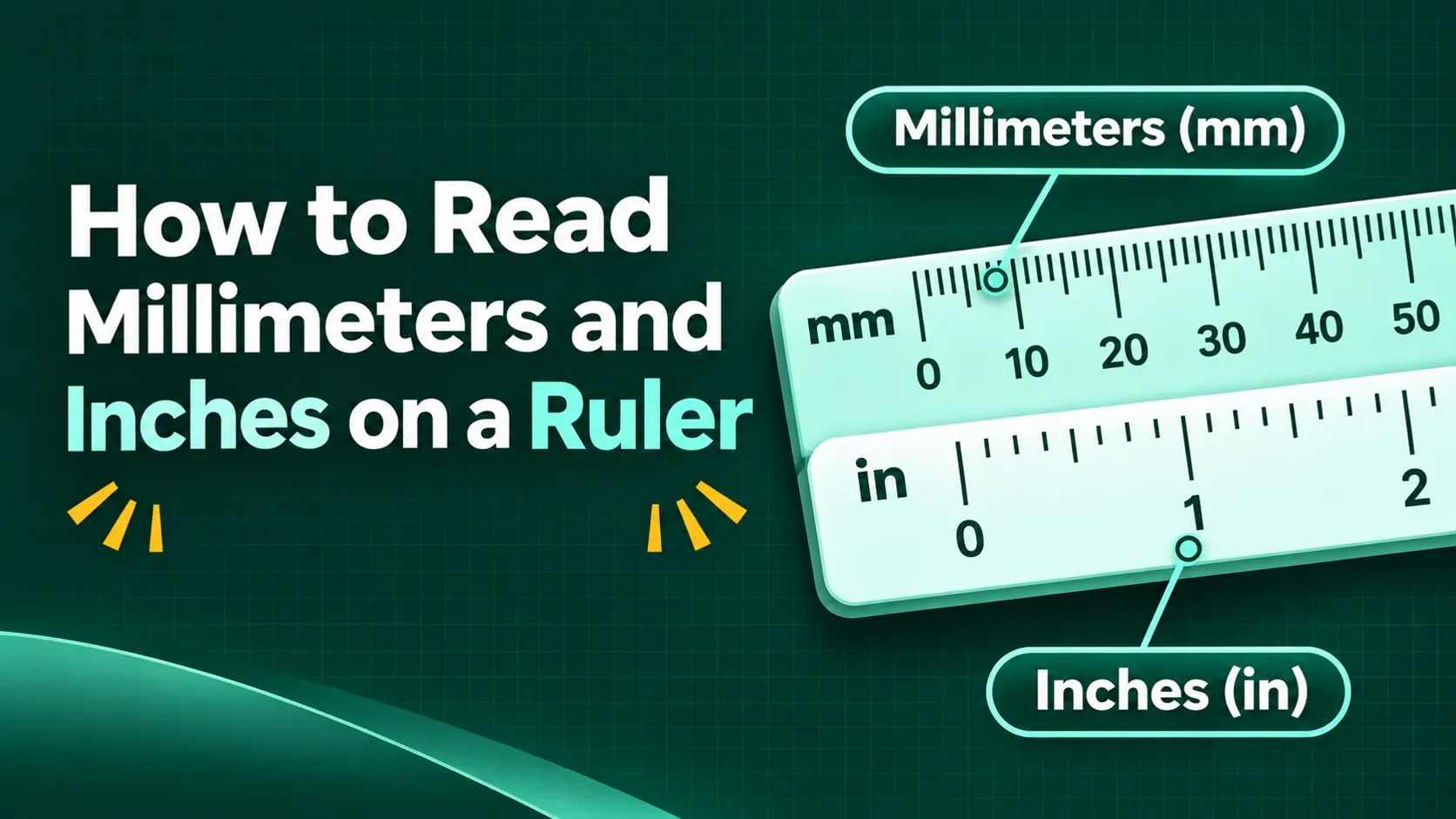
To read millimeters on a ruler, count the short lines from the zero mark, since each short line on the metric edge equals 1 millimeter and each numbered line equals 10 millimeters (1 centimeter). To read inches, count the whole inch numbers first, then count the 1/16-inch lines past the last whole inch and reduce the fraction. A standard 12-inch ruler carries both scales: inches on one edge and 30 centimeters (300 millimeters) on the other.
Metric and inch scales follow different logic. The metric edge divides by 10. The inch edge divides by 2 again and again, down to 1/16 or 1/32 of an inch. The sections below explain each scale, the order of the lines and how one reading on the metric edge converts to the inch edge.
What Do the Lines on a Ruler Mean?
The lines on a ruler mean fixed fractions of the base unit, and the length of each line shows its size in the hierarchy. Longer lines mark bigger divisions. Shorter lines mark smaller divisions.
A dual-scale ruler has 2 line systems:
- The metric edge uses 3 line lengths: long numbered lines for centimeters, medium lines for half centimeters (5 mm) and short lines for single millimeters.
- The inch edge uses 5 line lengths: whole inches, 1/2 inch, 1/4 inch, 1/8 inch and 1/16 inch.
The metric edge has 10 spaces between numbered lines. The inch edge has 16 spaces between numbered lines on a 1/16-inch ruler. That gap in counting logic is the reason inch readings end as fractions and millimeter readings end as whole numbers.
How Do You Read Millimeters on a Ruler?
To read millimeters on a ruler, multiply the last numbered centimeter by 10 and add the short lines that follow it. The total is the length in millimeters.
Follow these 5 steps:
- Place the object edge on the zero line, not on the physical end of the ruler.
- Find the last numbered line the object passes. This number is the centimeters.
- Multiply that number by 10 to convert centimeters to millimeters.
- Count the short lines between that numbered line and the object’s far edge.
- Add the counted lines to the result of step 3.
An object that ends 7 short lines after the number 4 measures 4 × 10 + 7 = 47 mm. The medium line at the halfway point between 4 and 5 marks 45 mm, which speeds up counting: 2 lines past the medium line equals 47 mm.
Some engineering rulers add half-millimeter lines, giving a resolution of 0.5 mm. A plain metric ruler reads to the nearest 1 mm, and an observer can estimate halfway between 2 lines for a reading to 0.5 mm.
How Do You Read Inches on a Ruler?
To read inches on a ruler, take the last whole inch number, count the 1/16-inch spaces past it and reduce the fraction to its lowest terms. Inch fractions use only denominators of 2, 4, 8 and 16 on a standard ruler.
Follow these 4 steps:
- Place the object edge on the zero line.
- Read the last whole inch number the object passes.
- Count the 1/16-inch spaces from that number to the object’s far edge.
- Reduce the count over 16: 4/16 becomes 1/4, 6/16 becomes 3/8 and 12/16 becomes 3/4.
An object that ends 6 spaces past the 2-inch line measures 2 6/16 inches, which reduces to 2 3/8 inches. The reduced fraction always has an odd numerator. 2 3/8 inches is the standard form and 2 6/16 inches is not.
What Is the Order of Inch Marks Between 0 and 1?
The order of inch marks between 0 and 1 follows 15 lines in 5 lengths, from the 1/2-inch line down to the 1/16-inch lines. The table below lists every mark with its decimal value and its exact millimeter value.
| Inch mark | Line length | Decimal inches | Millimeters (exact) |
|---|---|---|---|
| 1/16 | shortest | 0.0625 | 1.5875 |
| 1/8 | short | 0.125 | 3.175 |
| 3/16 | shortest | 0.1875 | 4.7625 |
| 1/4 | medium | 0.25 | 6.35 |
| 5/16 | shortest | 0.3125 | 7.9375 |
| 3/8 | short | 0.375 | 9.525 |
| 7/16 | shortest | 0.4375 | 11.1125 |
| 1/2 | long | 0.5 | 12.7 |
| 9/16 | shortest | 0.5625 | 14.2875 |
| 5/8 | short | 0.625 | 15.875 |
| 11/16 | shortest | 0.6875 | 17.4625 |
| 3/4 | medium | 0.75 | 19.05 |
| 13/16 | shortest | 0.8125 | 20.6375 |
| 7/8 | short | 0.875 | 22.225 |
| 15/16 | shortest | 0.9375 | 23.8125 |
| 1 | full | 1.0 | 25.4 |
Every millimeter value in the table is exact because each fraction multiplies 25.4 by a power-of-2 fraction. None of the 15 fractional marks lands on a whole millimeter. Even the 1/2-inch mark sits at 12.7 mm, between the 12 mm and 13 mm lines, so inch lines and millimeter lines on a dual-scale ruler meet exactly only at multiples of 5 inches (127 mm).
Why Do Millimeter and Inch Lines Not Line Up?
Millimeter and inch lines do not line up because one inch equals 25.4 millimeters, a length that is not a whole number of millimeters. The two scales share a common line only every 5 inches, at 127 mm, 254 mm and 381 mm.
The effect shows at the end of a 12-inch ruler. 12 inches equals 304.8 mm, so the 30 cm mark sits 4.8 mm before the 12-inch mark. A 30 cm metric ruler is shorter than a 12-inch ruler by that same 4.8 mm.
How Do You Convert a Ruler Reading From Millimeters to Inches?
To convert a ruler reading from millimeters to inches, divide the millimeter reading by 25.4, then round to the nearest 1/16 inch for a ruler-style answer. The reverse reading on the inch edge confirms the result.
A pencil that reads 175 mm on the metric edge converts as follows:
- Divide by 25.4: 175 ÷ 25.4 = 6.8898 inches.
- Separate the whole inches: 6 inches and 0.8898 inch.
- Multiply the decimal part by 16: 0.8898 × 16 = 14.24.
- Round to 14 and reduce: 14/16 = 7/8.
The pencil reads 6 7/8 inches on the inch edge. The MM to inches converter returns the decimal value for any metric reading. 6 7/8 inches equals 174.625 mm, so the inch reading sits 0.375 mm short of the metric reading. That gap is the rounding error of the 1/16-inch scale. The full rounding method, including 1/32 and 1/64 precision, is explained in how to convert MM to fractional inches.
Which Ruler Scale Gives the More Precise Reading?
The metric scale gives the more precise reading on a standard ruler, because its smallest division is 1 mm while the smallest inch division is 1/16 inch (1.5875 mm). The millimeter division is 37% finer than the 1/16-inch division.
The table below compares common ruler and tape divisions by their size in millimeters.
| Scale | Smallest division | Size in mm | Typical tool |
|---|---|---|---|
| Metric | 1 mm | 1.0 | School ruler, metric tape |
| Metric engineering | 0.5 mm | 0.5 | Steel rule |
| Inch, standard | 1/16 in | 1.5875 | School ruler, tape measure |
| Inch, woodworking | 1/32 in | 0.79375 | Steel rule, combination square |
| Inch, machinist | 1/64 in | 0.396875 | Machinist rule |
| Decimal inch | 1/100 in | 0.254 | Machinist rule |
A 1/32-inch ruler beats a plain metric ruler on resolution. A 1/64-inch machinist rule beats a 0.5 mm engineering rule. Resolution depends on the tool, not on the unit system alone.
What Are the Most Common Ruler Reading Errors?
There are 4 common ruler reading errors, and each one shifts the reading by a predictable amount.
- Parallax error: Viewing the scale at an angle shifts the apparent line. Reading straight down from above removes the shift.
- Worn zero end: Rulers with chipped or rounded ends start short. Measuring from the 1 cm line or the 1-inch line and subtracting it removes the error.
- Wrong edge: Reading the inch edge with metric counting gives values like “2.6 inches” for 2 6/16 inches. The two edges need separate counting rules.
- Unreduced fractions: Writing 4/16 instead of 1/4 is correct in value but breaks drawing and cut-list conventions.
Tape measures add a fifth source. The end hook slides by its own thickness so that inside and outside measurements both start at true zero. A bent hook removes that correction. US tape measures also print red marks every 16 inches for stud spacing and black diamonds every 19.2 inches for joist layouts. Neither mark is a unit boundary.
How Do You Measure Something Longer Than the Ruler?
To measure something longer than the ruler, mark the end of the first full ruler length on the object, move the ruler’s zero line to that mark and add the readings. The error grows with each move, so a tape measure is the better tool past 2 ruler lengths.
A shelf measured with a 300 mm ruler in 3 moves of 300 mm plus a final reading of 112 mm totals 1,012 mm. Each move adds about 0.5 mm of possible error, so the total carries up to 2 mm of uncertainty. The same shelf measures 39.84 inches, or 39 27/32 inches. Measuring technique and tool choice are covered in depth in how to measure length in millimeters and convert it to inches.
Frequently Asked Questions
How many millimeter lines are between two numbers on a ruler?
There are 9 short lines and 10 spaces between two numbered centimeter lines. Each space equals 1 mm, and the fifth line is longer to mark 5 mm.
How many lines are in one inch on a ruler?
A 1/16-inch ruler has 15 lines between two inch numbers, creating 16 spaces. A 1/32-inch ruler has 31 lines and 32 spaces.
Is the small line on a ruler 1 mm or 1/16 inch?
The small line is 1 mm on the metric edge and 1/16 inch on the inch edge. The metric edge is the one numbered up to 30.
How many mm is 1/16 on a ruler?
1/16 inch on a ruler is 1.5875 mm. This makes the smallest inch division about 1.6 times the smallest metric division.
Why is a 30 cm ruler not the same as 12 inches?
A 30 cm ruler is not the same as 12 inches because 12 inches equals 30.48 cm. The inch scale runs 4.8 mm longer.
Reading Millimeters and Inches on a Ruler: Summary
Reading millimeters and inches on a ruler uses two counting systems on one tool. The millimeter edge counts tens: numbered centimeter lines plus short millimeter lines. The inch edge counts halves: whole inches plus 1/16-inch spaces reduced to the lowest fraction. Because one inch equals exactly 25.4 millimeters, the two scales meet only every 127 mm, and any reading converts from millimeters to inches by dividing by 25.4.