MM to Inches: Worked Examples and Practice Questions (with Answers)
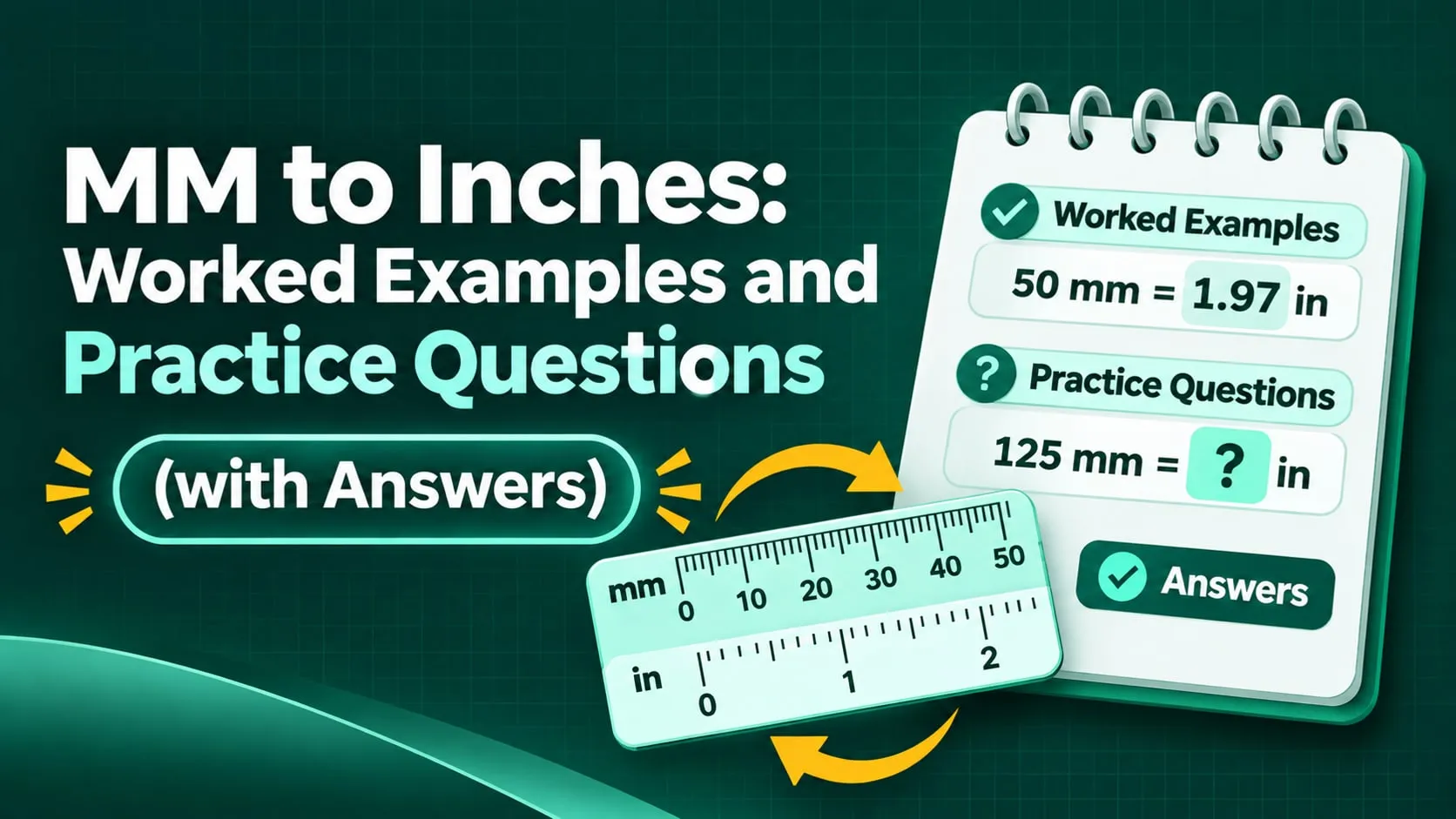
MM to inches conversion problems are solved with one formula: inches = millimeters ÷ 25.4. This page applies that formula to 8 worked examples and 30 practice questions across 3 difficulty levels. Every question has a full answer and every answer shows the working.
Level 1 covers whole-number conversions to 2 decimal places. Level 2 covers estimation, comparison and exact benchmark values. Level 3 covers fractional inches, feet and inches and multi-step word problems.
How Do You Solve an MM to Inches Problem Step by Step?
To solve an MM to inches problem, divide the millimeter value by 25.4, then round the result to the precision the question asks for. The 4 steps below apply to every example on this page.
- Write the length in millimeters.
- Divide the length by 25.4, or multiply it by 0.0393701.
- Round the result to the required decimal places or fraction.
- Check the answer by multiplying the inches by 25.4.
The divisor 25.4 is exact. One inch has equaled exactly 25.4 millimeters since the International Yard and Pound Agreement took effect on 1 July 1959, so rounding happens only in the final answer and never in the conversion factor.
What Do Worked MM to Inches Examples Look Like?
Worked MM to inches examples show the division, the rounding rule and the check in sequence. The 8 examples below move from simple values to real objects.
Example 1: How Many Inches Is 50 mm?
50 mm is 1.97 inches. The working is 50 ÷ 25.4 = 1.9685, rounded to 2 decimal places as 1.97. The check is 1.9685 × 25.4 = 50.0 mm.
Example 2: How Many Inches Is 127 mm?
127 mm is exactly 5 inches. The working is 127 ÷ 25.4 = 5. The result has no decimals because 127 is 5 whole multiples of 25.4.
Example 3: How Many Inches Is 6.35 mm?
6.35 mm is exactly 0.25 inches, which is 1/4 inch. The working is 6.35 ÷ 25.4 = 0.25. Drill bits and bolts labeled 1/4 inch measure 6.35 mm.
Example 4: How Many Inches Is an A4 Sheet?
An A4 sheet is 8.27 inches by 11.69 inches. ISO 216 sets the A4 size at 210 mm by 297 mm. The working is 210 ÷ 25.4 = 8.2677 and 297 ÷ 25.4 = 11.6929. US Letter paper measures 8.5 by 11 inches, so A4 is 0.23 inches narrower and 0.69 inches taller.
Example 5: How Many Inches Is a Bank Card?
A bank card is 3.37 inches by 2.13 inches. ISO/IEC 7810 sets the ID-1 card format at 85.60 mm by 53.98 mm. The working is 85.6 ÷ 25.4 = 3.3701 and 53.98 ÷ 25.4 = 2.1252.
Example 6: How Many Inches Is 1,000 mm?
1,000 mm is 39.37 inches, which equals 1 meter. The working is 1,000 ÷ 25.4 = 39.3701. One meter is 3.37 inches longer than one yard of 36 inches.
Example 7: Is a 225 mm Tire Wider Than 9 Inches?
No, a 225 mm tire is 8.86 inches wide, which is 0.14 inches narrower than 9 inches. The working is 225 ÷ 25.4 = 8.8583. In the tire size 225/45R17, the first number is the section width in millimeters and the last number is the rim diameter in inches.
Example 8: How Many Inches of Rain Is 38 mm?
38 mm of rain is 1.50 inches. The working is 38 ÷ 25.4 = 1.4961, rounded to 1.50. Weather services in metric countries report rainfall in millimeters, while the US National Weather Service reports rainfall in inches.
Level 1 Practice Questions: Whole MM Values to Decimal Inches
Level 1 contains 10 questions that convert whole or simple millimeter values to inches, rounded to 2 decimal places. Divide each value by 25.4.
- Convert 15 mm to inches.
- Convert 40 mm to inches.
- Convert 65 mm to inches.
- Convert 88 mm to inches.
- Convert 120 mm to inches.
- Convert 178 mm to inches.
- Convert 235 mm to inches.
- Convert 400 mm to inches.
- Convert 610 mm to inches.
- Convert 2.5 mm to inches.
Level 1 Answers
The answer table lists each division and the rounded result. Values are rounded to 2 decimal places from a 4-decimal working value.
| Question | Working | Answer |
|---|---|---|
| 1 | 15 ÷ 25.4 = 0.5906 | 0.59 in |
| 2 | 40 ÷ 25.4 = 1.5748 | 1.57 in |
| 3 | 65 ÷ 25.4 = 2.5591 | 2.56 in |
| 4 | 88 ÷ 25.4 = 3.4646 | 3.46 in |
| 5 | 120 ÷ 25.4 = 4.7244 | 4.72 in |
| 6 | 178 ÷ 25.4 = 7.0079 | 7.01 in |
| 7 | 235 ÷ 25.4 = 9.2520 | 9.25 in |
| 8 | 400 ÷ 25.4 = 15.7480 | 15.75 in |
| 9 | 610 ÷ 25.4 = 24.0157 | 24.02 in |
| 10 | 2.5 ÷ 25.4 = 0.0984 | 0.10 in |
Questions 6 and 9 land close to whole inches. 178 mm is 0.2 mm longer than 7 inches, and 610 mm is 0.4 mm longer than 24 inches. Values near whole inches are useful anchors for estimation in Level 2.
Level 2 Practice Questions: Estimation, Comparison and Exact Values
Level 2 contains 10 questions that combine mental estimation with exact conversion. Estimate each answer with the ×0.04 shortcut first, then calculate the exact value to 3 decimal places. The shortcut is explained in how to convert MM to inches without a calculator.
- Which is longer, 200 mm or 8 inches?
- Which is longer, a 300 mm ruler or a 12-inch ruler?
- Convert 0.5 mm to inches.
- Convert 1.2 mm to inches.
- Convert 12.7 mm to inches.
- Convert 63.5 mm to inches.
- Convert 82.55 mm to inches.
- Convert 762 mm to inches.
- A phone measures 147.6 mm tall. How tall is it in inches?
- A student converts 50 mm and gets 19.69 inches. What went wrong?
Level 2 Answers
The answer table gives the shortcut estimate beside the exact result. The gap between the two columns shows the 1.6% overestimate of the shortcut.
| Question | Estimate (×0.04) | Exact working | Answer |
|---|---|---|---|
| 1 | 8.00 in | 200 ÷ 25.4 = 7.874 | 8 inches is longer by 0.126 in (3.2 mm) |
| 2 | 12.00 in | 300 ÷ 25.4 = 11.811 | The 12-inch ruler is longer by 4.8 mm |
| 3 | 0.020 in | 0.5 ÷ 25.4 = 0.0197 | 0.020 in |
| 4 | 0.048 in | 1.2 ÷ 25.4 = 0.0472 | 0.047 in |
| 5 | 0.508 in | 12.7 ÷ 25.4 = 0.5 | 0.500 in exactly |
| 6 | 2.540 in | 63.5 ÷ 25.4 = 2.5 | 2.500 in exactly |
| 7 | 3.302 in | 82.55 ÷ 25.4 = 3.25 | 3.250 in exactly |
| 8 | 30.480 in | 762 ÷ 25.4 = 30 | 30.000 in exactly |
| 9 | 5.904 in | 147.6 ÷ 25.4 = 5.811 | 5.811 in |
| 10 | 2.000 in | 50 ÷ 25.4 = 1.969 | The student divided by 2.54, not 25.4 |
Questions 5 to 8 are exact multiples of 25.4, so each answer has no repeating decimals. Question 10 shows the most frequent error in MM to inches problems: dividing by 2.54 converts centimeters to inches, so the answer comes out 10 times too large. A 12-inch ruler equals 304.8 mm, which explains question 2.
Level 3 Practice Questions: Fractions, Feet and Word Problems
Level 3 contains 10 multi-step questions that use fractional inches and feet. Round fractions to the nearest 1/16 inch unless the question states 1/32.
- Convert 22 mm to the nearest 1/16 inch.
- Convert 45 mm to the nearest 1/32 inch.
- Convert 9.5 mm to the nearest 1/16 inch.
- Convert 1,750 mm to feet and inches.
- Convert 1,800 mm to feet and inches.
- A bookshelf is 900 mm wide. Does it fit in a 36-inch alcove?
- Three boards each 600 mm long are joined end to end. What is the total length in inches?
- A TV has a 55-inch diagonal. What is the diagonal in millimeters?
- A 20 mm pipe and a 3/4 inch pipe are compared. Which outer diameter is larger?
- A door opening is 2,032 mm tall. How tall is it in feet and inches?
Level 3 Answers
The answer table shows the decimal result, the rounding step and the final answer. Fraction rounding multiplies the decimal part by 16 or 32 and rounds to the nearest whole number.
| Question | Working | Answer |
|---|---|---|
| 1 | 22 ÷ 25.4 = 0.866; 0.866 × 16 = 13.86 → 14/16 | 7/8 in |
| 2 | 45 ÷ 25.4 = 1.7717; 0.7717 × 32 = 24.69 → 25/32 | 1 25/32 in |
| 3 | 9.5 ÷ 25.4 = 0.374; 0.374 × 16 = 5.98 → 6/16 | 3/8 in |
| 4 | 1,750 ÷ 25.4 = 68.898 in; 68.898 − 60 = 8.898 | 5 ft 8.9 in |
| 5 | 1,800 ÷ 25.4 = 70.866 in; 70.866 − 60 = 10.866 | 5 ft 10.87 in |
| 6 | 900 ÷ 25.4 = 35.433 in | Yes, with 0.567 in (14.4 mm) to spare |
| 7 | 3 × 600 = 1,800 mm; 1,800 ÷ 25.4 = 70.866 | 70.87 in |
| 8 | 55 × 25.4 = 1,397 | 1,397 mm |
| 9 | 20 ÷ 25.4 = 0.787 in; 3/4 in = 0.750 in | 20 mm is larger by 0.95 mm |
| 10 | 2,032 ÷ 25.4 = 80 in; 80 ÷ 12 = 6 r 8 | 6 ft 8 in exactly |
Question 10 matches the standard US interior door height of 80 inches. Question 9 shows why metric and inch pipe fittings are not interchangeable even when the sizes look close. The method behind questions 4, 5 and 10 is covered step by step in converting millimeters to feet and inches, and the rounding rule behind questions 1 to 3 is covered in how to convert MM to fractional inches.
What Are the Most Common Mistakes in MM to Inches Questions?
There are 5 common mistakes in MM to inches questions, and each produces a recognizable wrong answer.
- Dividing by 2.54 instead of 25.4, which makes the answer 10 times too large.
- Multiplying by 25.4 instead of dividing, which makes the answer 645 times too large.
- Rounding the conversion factor to 25, which makes the answer 1.6% too large.
- Rounding the decimal part to tenths before converting to a fraction, which shifts the fraction by up to 0.05 inch.
- Writing feet and inches as a decimal, such as 5.9 feet for 5 feet 10.87 inches.
A size check catches the first 2 mistakes. An inch answer is always about 1/25 of the millimeter value. Any answer outside that range signals a decimal or direction error.
Frequently Asked Questions
What is the formula used in every MM to inches question?
The formula is inches = mm ÷ 25.4. The equivalent multiplication form is inches = mm × 0.0393701.
How many decimal places does an MM to inches answer have?
An MM to inches answer has the number of decimal places the question states, usually 2 for general work and 3 for engineering. Fractions to the nearest 1/16 inch are standard for woodworking.
Which MM values convert to whole inches?
Multiples of 25.4 mm convert to whole inches. 25.4 mm, 50.8 mm, 127 mm, 254 mm and 762 mm convert to 1, 2, 5, 10 and 30 inches.
Why is 25 mm not equal to 1 inch?
25 mm is not equal to 1 inch because one inch is 25.4 mm, so 25 mm is 0.9843 inches. The 0.4 mm gap adds up to 4 mm across 10 inches.
How do you check an MM to inches answer?
To check an MM to inches answer, multiply the inches by 25.4 and compare the product with the starting millimeters. 1.9685 × 25.4 returns 50 mm.
MM to Inches Worked Examples and Practice: Summary
MM to inches worked examples and practice questions all use one exact formula, inches = mm ÷ 25.4. The 8 worked examples convert paper, cards, tires and rainfall. The 30 practice questions build from decimal conversion to estimation, fractional inches and feet-and-inches word problems. Each answer includes the working, so every MM to inches conversion on this page can be checked by multiplying back by 25.4.